
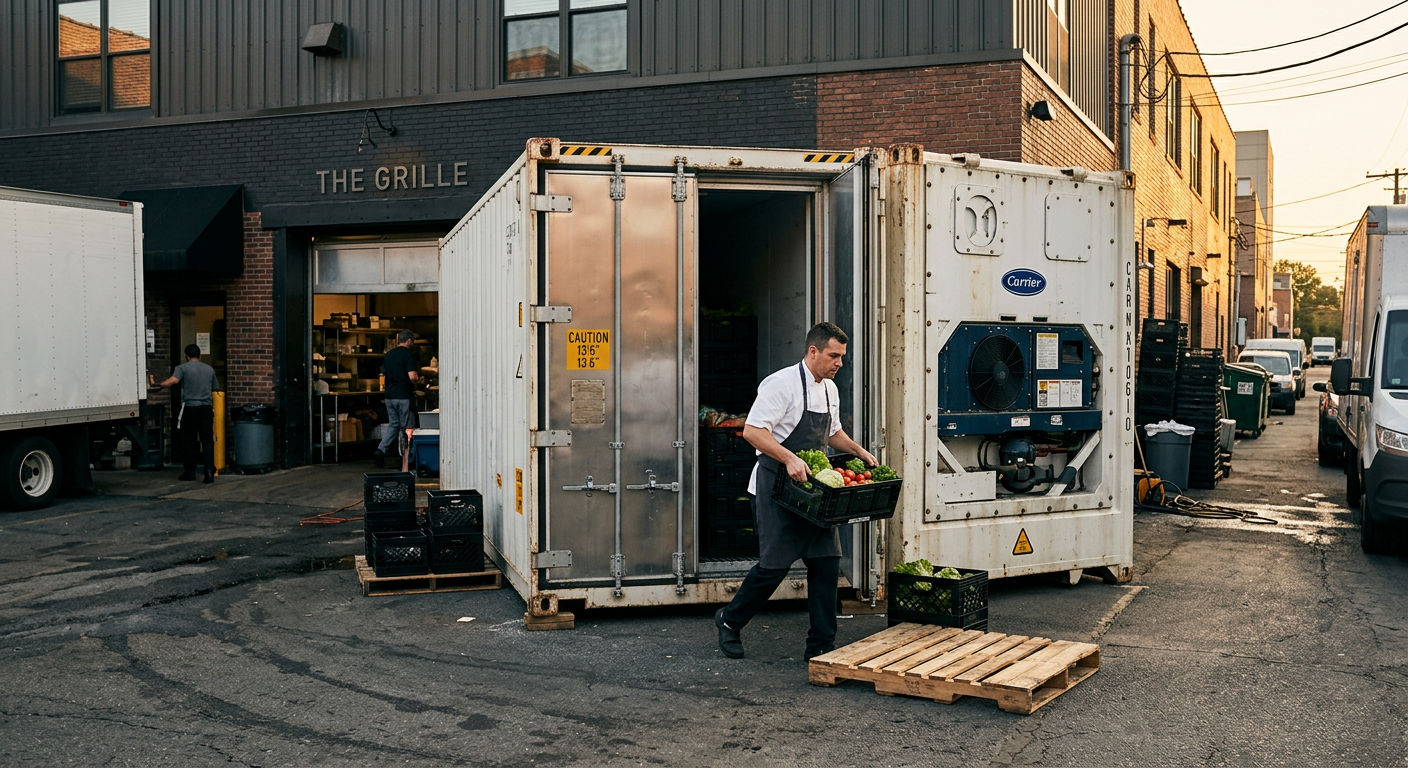
A practical guide for restaurant owners comparing refrigerated shipping containers for purchase or rent, including cost factors, site needs, and questions to ask before you commit.
Why Restaurants Consider Refrigerated Containers
Restaurants that need more cold storage often face a familiar squeeze: the walk-in is full, the prep line is crowded, and adding permanent construction is expensive or impossible on the current site. A refrigerated shipping container — sometimes called a reefer — is one option that can add temperature-controlled space without building a new room from scratch.
Reefers are insulated containers with an integrated refrigeration unit. They are commonly used for food distribution, floral, and other temperature-sensitive cargo. For a restaurant, a reefer can serve as an outdoor walk-in cooler alternative, an overflow freezer, or a staging area for deliveries. But the decision is not just about the box. It is about purchase versus rental, power, placement, sanitation, and ongoing operating costs.
This guide walks through the decision points without pretending there is one right answer. Your best path depends on your menu, your volume, your lease, your site, and how long you need the capacity.
Purchase vs. Rental: What Each Model Really Costs
The sticker price of a container is only one line in the budget. To compare fairly, look at total cost of ownership over the time you expect to need the unit.
Buying a Refrigerated Container
When you buy, you typically pay once for the asset, then cover ongoing costs. Common cost categories include:
- Acquisition cost — the container itself. Pricing varies widely by size, age, condition, refrigeration unit brand, and whether it is a standard reefer or a specialized unit.
- Delivery and placement — transport to your site, plus any equipment needed to set it down. Site access matters here.
- Site preparation — a level, stable pad or surface. Some sites need gravel, concrete, or blocking.
- Power connection — an electrician may need to run a circuit suitable for the reefer unit. The required amperage depends on the specific unit.
- Ongoing electricity — refrigeration runs continuously, and power consumption depends on unit efficiency, outdoor temperature, how often doors open, and the temperature setpoint.
- Maintenance and repairs — filters, coils, refrigerant, door seals, and eventually compressor or unit service.
- Monitoring — temperature alarms or remote monitoring if you need documented temperature control.
Buying can make sense when you expect to need the capacity for years, when you want to customize the interior, or when rental availability in your area is limited. It also gives you an asset that may hold residual value, though resale depends on condition and market demand.
Renting or Leasing a Refrigerated Container
Rental spreads cost over time and can reduce upfront capital. Typical rental structures include:
- Monthly rental — a recurring fee for the unit, often with a minimum term.
- Delivery and pickup — charged separately and based on distance and access.
- Power and fuel — you usually pay for electricity; some units may have different power arrangements.
- Damage and cleaning — responsibilities are defined in the rental agreement.
- Minimum term and renewal — know what happens at the end of the term.
Renting can make sense for seasonal demand, a temporary pop-up, a renovation period, or when you want to test whether outdoor cold storage works for your operation before committing capital. The trade-off is that you build no equity, and long-term rental can exceed purchase cost over enough time.
A Simple Way to Frame the Comparison
Rather than guessing, write down:
- How many months or years you expect to need the capacity.
- Your best estimate of purchase price plus delivery, site work, and electrical.
- Your best estimate of monthly rental plus delivery and pickup.
- Estimated monthly electricity and maintenance for each option.
- The value you place on flexibility, ownership, and customization.
Multiply the rental estimate by your expected months and compare. If the numbers are close, weigh the non-financial factors: flexibility, maintenance responsibility, and whether you want a permanent fixture on your site.
Size, Temperature, and Specification Decisions
Refrigerated containers are available in a range of sizes and configurations. Nominal container lengths are commonly around 10, 20, and 40 feet, with widths around 8 feet. Heights vary between standard and high-cube profiles. Exact interior dimensions, door openings, and weight limits vary by unit and should be confirmed on the individual listing and the container's CSC plate.
Key specification questions for restaurant use:
- Temperature range — can the unit hold the temperature you need for fresh, frozen, or mixed storage? Confirm the unit's rated range rather than assuming.
- Single vs. multi-temperature — some operations need two zones; that usually means different equipment.
- Flooring and drainage — food storage often involves washdown and spills. Confirm how the floor handles moisture and whether drainage is present.
- Door type and opening — how wide is the access, and does it work with your carts, racks, or pallets?
- Interior finish — bare container walls may not meet your sanitation expectations. Some buyers add liners, shelving, or paneling.
- Refrigeration unit condition — age, service history, and parts availability matter. Ask what is documented.
- Power requirements — voltage, phase, and amperage vary. Your electrician should review the unit's nameplate before you commit.
Do not rely on a general rule of thumb to match a container size to a specific number of covers, shelves, or rooms. Capacity depends on how you rack and stack, aisle width, and the temperature zones you need. Measure your actual storage plan.
Site Planning and Delivery Considerations
A refrigerated container is heavy and needs power, so site planning deserves attention before you buy or rent.
Access and Placement
- Approach path — can a delivery truck and any placement equipment reach the spot?
- Overhead clearance — check wires, branches, and building overhangs along the route.
- Ground conditions — soft ground, slopes, and drainage can affect placement and stability.
- Setback and appearance — consider how the unit looks from the street and whether your lease or local rules restrict outdoor equipment.
Power and Utilities
- Confirm the available electrical service at the intended location.
- Have a licensed electrician evaluate the circuit, disconnect, and any conduit run.
- Consider whether you want a backup plan for power interruptions, especially for frozen goods.
Permits and Local Requirements
Rules vary by jurisdiction and by how the unit is used. A temporary unit on a construction site, a permanent outdoor cooler at a restaurant, and a storage container in a parking lot may be treated differently. Contact your local planning or code office to ask what applies to your situation. Do not assume that one size or use type requires fewer approvals than another.
Sanitation and Operations
If the container will hold food, talk with your health department early. They may have expectations about surfaces, drainage, pest control, and temperature monitoring. Build those requirements into your plan before delivery, because retrofitting after placement is harder.
Maintenance and Ongoing Operating Costs
Refrigeration equipment works harder in hot, humid conditions. Ongoing costs to plan for include:
- Electricity — the largest recurring cost for most operations. Efficiency, insulation, door discipline, and outdoor temperature all affect it.
- Preventive maintenance — coil cleaning, filter changes, seal inspection, and unit service.
- Repairs — compressors, fans, controls, and refrigerant work can be significant. Ask about service availability for the unit's brand in your area.
- Monitoring — temperature alarms or logging may be required by your food safety plan.
- Cleaning and pest control — regular schedules keep the unit usable and inspection-ready.
A well-maintained unit tends to last longer and use less energy. A neglected one can erase the savings of buying used.
Questions to Ask Before You Commit
Use this checklist with any seller or rental provider:
- What is the exact model and rated temperature range of the refrigeration unit?
- What is the unit's service history, and what documentation is available?
- What are the power requirements, and has the unit been tested recently?
- What are the interior dimensions, door opening, and floor condition?
- What is included in delivery, and what site access is required?
- For rentals: what is the minimum term, and what are the pickup and damage terms?
- For purchases: what, if anything, is covered after the sale?
- What local approvals might apply to my intended use?
For exact specifications, availability, pricing, and delivery requirements, confirm details with the Newport team and review the individual listing.
Frequently Asked Questions
Is a refrigerated container cheaper to buy or rent?
It depends on how long you need it. Renting usually costs less upfront and is often better for short-term or seasonal needs. Buying usually makes more sense over a long horizon, but only after you add delivery, site work, electrical, power, and maintenance to the purchase price. Run the comparison over your expected time frame rather than comparing only the monthly rental rate to the purchase price.
Can a refrigerated container replace a walk-in cooler?
It can serve as an outdoor walk-in cooler alternative for some operations, but it is not a drop-in replacement. You need to confirm temperature range, interior finish, drainage, shelving, power, and local health department expectations. Some restaurants use a reefer as overflow or staging rather than as their primary cooler. Discuss your specific use with your health inspector and the Newport team.
What size refrigerated container do I need for a restaurant?
There is no reliable formula that converts container size to covers or storage volume. Capacity depends on your racking, aisle width, product mix, and whether you need separate temperature zones. Nominal lengths are commonly around 10, 20, and 40 feet, but exact interior dimensions vary. Measure your planned layout and confirm specifications on the individual listing.
Do I need a permit for a refrigerated container?
Requirements vary by jurisdiction and by how the unit is used and how long it stays. A temporary unit and a permanent outdoor cooler may be treated differently. Contact your local planning or code office to ask what applies to your site. Do not assume any particular size or use avoids approvals.
What ongoing costs should I expect?
Plan for electricity, preventive maintenance, possible repairs, cleaning, pest control, and any temperature monitoring your food safety plan requires. Electricity is often the largest recurring cost, and it varies with climate, unit efficiency, and how the container is used. Ask the Newport team what documentation is available for a specific unit so you can estimate more accurately.
Next Steps
Start by defining your temperature needs, your expected duration, and your site constraints. Then compare purchase and rental options against those requirements rather than against each other in the abstract.
Browse current refrigerated and storage container listings at our shop to see what is available and review individual specifications. When you are ready to talk through access, power, delivery, and timing, contact the Newport team with your questions. Confirm listing details, availability, pricing, site access, and delivery requirements directly with us before making a decision.
Plan the next step
Confirm the container and the delivery plan.
Browse current listings, then speak with the Newport team to verify the unit, total pricing, site access, and delivery requirements before payment.