
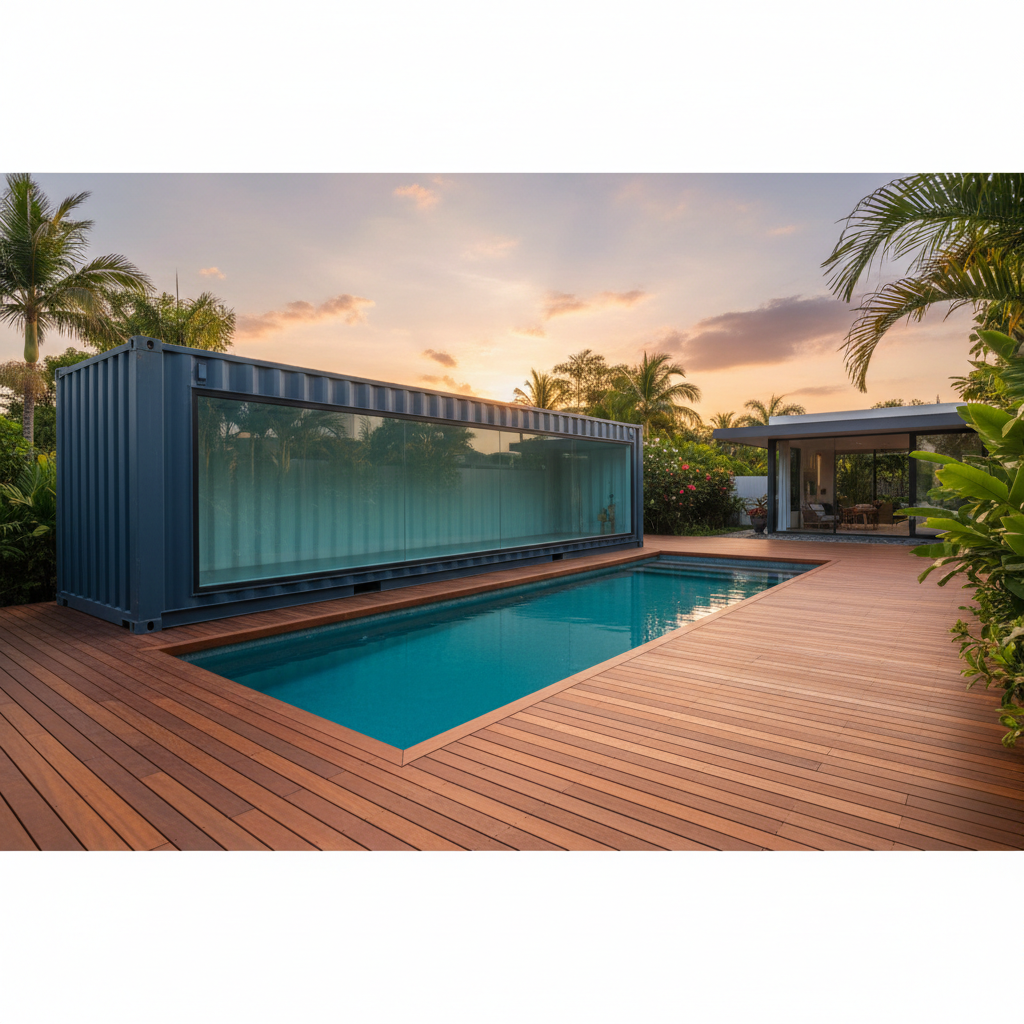
Planning a shipping container pool? Learn the typical build stages, structural and corrosion considerations, finish options, and the questions to confirm before you buy.
A shipping container pool can be an appealing project for homeowners who want a compact, modern water feature with an industrial look. But the gap between a used container and a finished, safe pool is wide. This guide walks through the typical build stages, explains why each step matters, and highlights the decisions and unknowns you should resolve before committing.
Container pools are site-built products. Two builders can start with similar containers and end up with very different results depending on steel condition, reinforcement design, waterproofing system, and local code requirements. Treat every specification below as a starting point for questions, not a guarantee.
Understanding the Container Before You Cut
Condition and History Matter More Than Size
A pool shell puts unusual stress on a container. The corrugated walls and thin floor were designed to carry cargo and resist racking, not to hold water. Before any cutting begins, a builder should inspect for rust, dents, repaired panels, and prior chemical cargo. A container with structural corrosion may not be a safe candidate no matter how attractive the price.
Ask to see the container's CSC plate and any available inspection records. Confirm with the Newport team what documentation accompanies a specific listing, because records vary by unit.
Nominal Dimensions Are Approximate
Standard containers are commonly described as about 20 feet or 40 feet long and roughly 8 feet wide, with standard and high-cube height options. Exact internal and external dimensions vary by manufacturer and unit. Do not finalize a pool design, deck, or equipment pad from a generic size chart. Confirm the actual measurements of the specific container, and remember that reinforcement and interior finishes reduce usable water volume.
Structural Reinforcement and Water Load
Why a Bare Container Is Not Enough
Water is heavy. A filled pool pushes outward on the walls and downward on the floor continuously. Without reinforcement, wall panels can bow, welds can crack, and the shell can distort. Reinforcement is not an optional upgrade in most builds; it is part of making the structure behave like a pool.
Typical approaches include:
- Internal steel framing or ribs welded to the walls
- External bracing or a surrounding structural frame
- Reinforced floor support or a concrete slab beneath the container
- Gussets or plates at cut openings for skimmers, returns, and steps
The Cutouts Are Structural Events
Every opening for a window, skimmer, light, or entry step interrupts the container's original load path. A builder should plan all penetrations before cutting and add framing around each one. Cutting first and reinforcing later is a common source of problems.
Engineering and Local Requirements
A container pool is a structure and often a regulated pool. Requirements for permits, setbacks, barriers, electrical bonding, and inspections vary by jurisdiction. Confirm with your local building authority what applies to your property. Do not assume that a container pool avoids permits because it is not a traditional concrete pool.
Waterproofing, Coatings, and Interior Finish
The Waterproofing Layer Is the Critical System
Steel and water are long-term enemies. Even with coatings, any breach can lead to corrosion behind the finish. Builders typically combine surface preparation, a primer, and a waterproof membrane or coating system rated for continuous immersion. The specific products and their compatibility matter more than brand names.
Questions worth asking:
- What surface preparation is used before coating?
- Is the system rated for permanent immersion, not just splash exposure?
- How are seams, welds, and penetrations detailed?
- What is the recoat or inspection interval?
Interior Finish Options
Finish choices affect feel, maintenance, and cost:
- Exposed steel with protective coating: industrial look, requires careful coating maintenance.
- Tile or mosaic: familiar pool feel, adds weight and installation complexity.
- Plaster or aggregate finishes: traditional appearance, needs a suitable substrate.
- Liner systems: can simplify waterproofing, but require precise fit and edge detailing.
Each option interacts with the reinforcement and waterproofing design. Changing finish late in the build can force rework.
Corrosion Protection Inside and Out
The exterior also needs attention. Coastal or humid environments accelerate corrosion, and pool chemicals add another stress inside. Ventilation, drainage around the container, and a maintenance routine all influence how long the shell lasts. Ask the builder how they address condensation and airflow in enclosed or partially buried designs.
Equipment, Plumbing, and Electrical Planning
Circulation and Filtration
A container pool still needs a pump, filter, and circulation plan sized to the actual water volume and layout. Because container pools are often compact, equipment selection and placement can be tight. Plan access for service and winterization from the beginning.
Plumbing Runs and Penetrations
Every pipe penetration is a potential leak path. Fewer, well-sealed penetrations are generally easier to maintain than many small ones. Confirm how the builder seals and supports each line, and where valves and drains will be accessible.
Electrical and Bonding
Pool electrical work involves bonding and grounding requirements that protect people in and around the water. This is not a do-it-yourself area. Work with a licensed electrician who understands pool code in your area, and confirm inspection requirements with your local authority.
Access for Installation
A finished container pool may arrive as a shell to be finished on site, or as a largely completed unit. Either way, plan how equipment and materials reach the yard. Site access, crane or lift needs, and utility routes are project-specific. Confirm delivery and site requirements with the Newport team before you commit to a layout.
Site Preparation and Installation Sequence
A Typical Build Order
Every project differs, but a common sequence looks like this:
- Select and inspect the container.
- Finalize the design, cut plan, and reinforcement drawings.
- Obtain local approvals and confirm inspection points.
- Reinforce the shell and frame all openings.
- Prepare the base, slab, or foundation.
- Set the container and complete structural connections.
- Install plumbing, electrical rough-in, and equipment pads.
- Apply waterproofing and interior finish.
- Install coping, decking, and safety barriers.
- Commission equipment, test for leaks, and schedule inspections.
Where Projects Go Wrong
- Reinforcement designed after cutouts are made
- Waterproofing applied over poorly prepared or contaminated steel
- Equipment sized without accounting for actual water volume
- Permits and inspections treated as an afterthought
- No plan for service access or future recoating
Budget and Timeline Uncertainty
Container pools can range widely in cost depending on reinforcement, finish, equipment, site work, and local labor. Rather than relying on a general number, ask for a scope-based estimate that separates the container, fabrication, finishes, equipment, and site work. Timelines also depend on inspections and material lead times. Confirm current pricing, availability, and lead times with the Newport team for the specific container you are considering.
Frequently Asked Questions
Can any shipping container be turned into a pool?
Not safely. Structural condition, corrosion, and prior cargo all affect suitability. A builder should inspect the specific unit and confirm it can be reinforced appropriately. Ask the Newport team what inspection information is available for a given listing.
How long does a container pool build take?
Timelines vary with design complexity, permits, inspections, material lead times, and site conditions. A simple shell may move faster than a fully finished pool with tile, decking, and automated equipment. Get a project-specific schedule rather than a general estimate.
Do container pools need permits?
In many places, yes. Pools are often regulated for safety barriers, electrical work, setbacks, and inspections. Requirements differ by jurisdiction, so confirm with your local building authority. Do not assume a container pool is exempt.
How much maintenance does the coating need?
Immersion-rated coating systems generally need periodic inspection and eventual recoating, but intervals depend on the product, water chemistry, and environment. Ask the installer for a maintenance schedule and keep records.
Can I install a container pool myself?
Some site work and preparation may be within reach for experienced owners, but structural reinforcement, waterproofing, and pool electrical work carry real safety and performance risks. Most projects benefit from qualified fabricators, electricians, and inspectors.
Next Steps for Your Container Pool Project
Start by defining your goals: approximate water size, finish style, equipment preferences, and how the pool will be accessed and serviced. Then confirm the details that only the specific unit and your site can answer.
- Browse available containers and listings at our shop to review current options.
- Talk through reinforcement, delivery, and site questions with the Newport team.
Before you buy, confirm listing details, availability, pricing, site access, and delivery requirements with Newport. For exact dimensions, review the individual listing and CSC plate. For permits and code requirements, consult your local authority. A careful planning phase is the best way to keep a container pool project safe, buildable, and enjoyable.
Plan the next step
Confirm the container and the delivery plan.
Browse current listings, then speak with the Newport team to verify the unit, total pricing, site access, and delivery requirements before payment.