
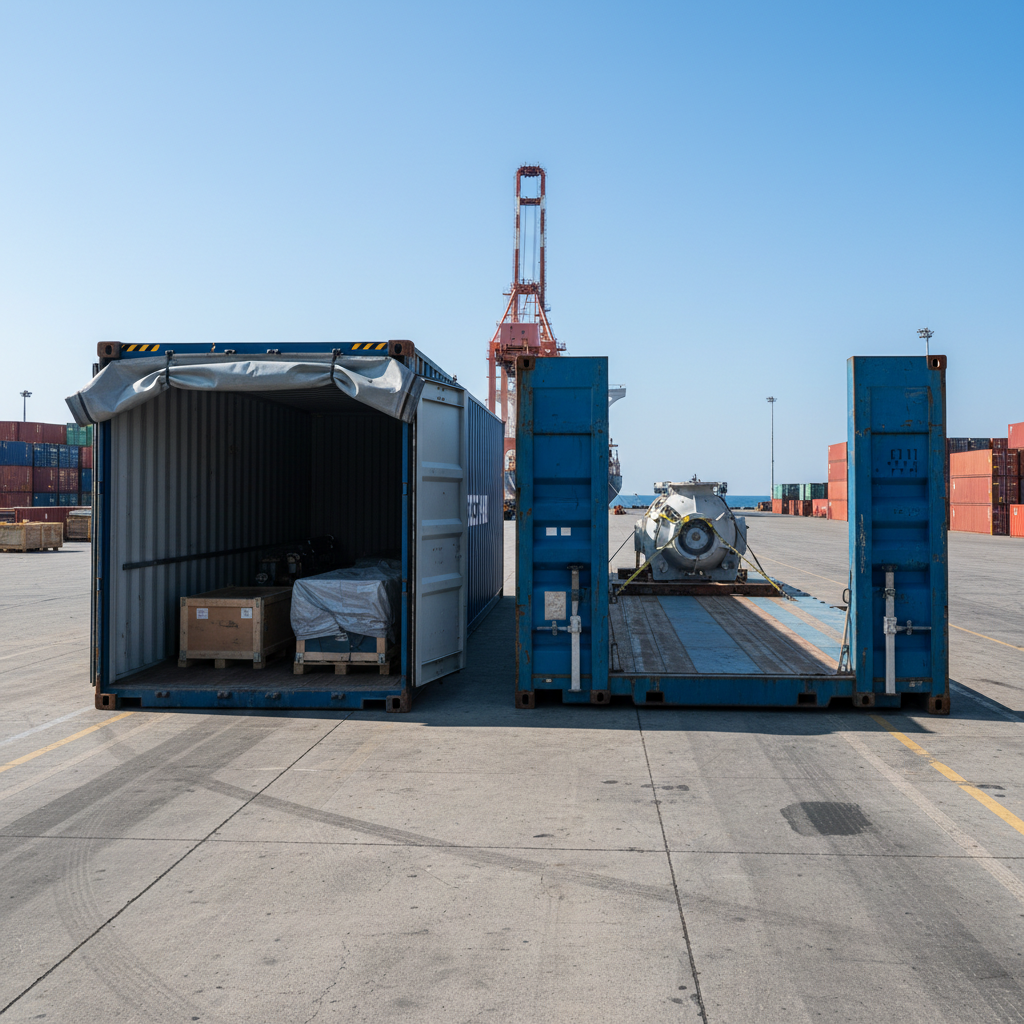
Compare open-top and flat-rack containers for moving heavy or oversized equipment, with practical guidance on loading, securing, and when to ask for help.
Start With the Load, Not the Container
When you need to move heavy equipment, the first question is not "which container is best?" but "what am I actually loading?" Open-top and flat-rack containers solve different problems. Choosing the wrong one can mean a load that will not fit, cannot be secured, or cannot be handled safely at either end of the trip.
This guide explains how each type works in general terms, where each tends to shine, and what you should confirm with the Newport team before you buy or book anything.
What an Open-Top Container Is and When It Helps
An open-top container is a standard-height or high-cube box with a removable roof or an open top covered by a tarpaulin. The walls and doors are still in place, so cargo is protected on the sides and ends. The open roof allows loading from above by crane or overhead lift.
Typical characteristics
- Roof access. The top can be opened or removed so tall or awkward items can be lowered in.
- Enclosed sides. Cargo is shielded from weather and casual damage on the sides and ends.
- Standard footprint. Open-top units generally follow the same nominal length and width as a standard dry container, with standard or high-cube height options.
- Door access. Cargo can also be loaded through the end doors when the shape allows.
Where open-top containers tend to fit
Open-top containers are often a good starting point when equipment is tall but still fits within the container's internal height and width, and when you want the protection of enclosed walls. Examples might include machinery that is slightly too tall for a standard door opening, or items that are easier to lower in from above than to slide in from the end.
What to watch
- Height limits still apply. An open roof does not remove the container's internal height. Measure the tallest point of your equipment, including any fixed protrusions.
- Tarp coverage. The tarp protects the top, but it is not a structural roof. Confirm what weather protection the listing includes.
- Lifting plan. You need a way to lift the item over the top and lower it in safely. That may require a crane, gantry, or other overhead equipment, which is a site-planning question.
What a Flat-Rack Container Is and When It Helps
A flat-rack container is essentially a platform with a base and end walls, with no side walls and no roof. It is designed for cargo that is too wide, too tall, or too oddly shaped to fit inside a closed box.
Typical characteristics
- Open sides and top. There is no enclosure, so cargo can overhang the sides and rise above the base.
- End walls. Collapsible or fixed end walls provide some structure and tie-down points, depending on the unit.
- Platform base. The base carries the load and provides a surface for blocking and bracing.
- Handling points. Flat racks are generally handled with cranes or specialized lifting gear, and the base is built for that kind of handling.
Where flat racks tend to fit
Flat racks are often considered for equipment that is wider than a standard container interior, taller than an open-top interior, or shaped in a way that makes lowering it into a box impractical. They are also common when the load needs to be secured directly to a platform with chains, straps, or blocking.
What to watch
- No weather protection. Cargo on a flat rack is exposed. If the equipment is sensitive to rain, salt air, or dust, you need a covering plan.
- Securing is on you. Lashing, blocking, and bracing are part of the shipment plan. The right method depends on the load, the route, and the carrier's requirements.
- Overhang matters. Width and height overhangs can affect handling, road transport, and terminal acceptance. Confirm limits with the carrier and terminal before you commit.
Open-Top vs Flat-Rack: A Practical Comparison
| Question | Open-top container | Flat-rack container |
|---|---|---|
| Is the cargo enclosed? | Sides and ends enclosed; top open | Open on sides and top |
| Can cargo be wider than the base? | Generally no, within the box | Often yes, subject to carrier limits |
| Can cargo be taller than the box? | No, internal height applies | Yes, subject to carrier limits |
| Loading method | Overhead lift into the top, or through doors | Overhead lift onto the platform |
| Weather protection | Tarp over the top; walls on sides | None unless you add a cover |
| Securing method | Inside the box, tied to internal points | Directly to the platform with lashing and blocking |
| Best fit | Tall-but-contained equipment | Wide, tall, or irregular equipment |
This table is a starting point, not a specification sheet. Exact dimensions, ratings, and tie-down arrangements vary by unit. Always check the individual listing and the container's CSC plate for the details that apply to that specific box.
How to Decide Between the Two
Work through these questions in order. If you get stuck, that is a signal to call the Newport team rather than guess.
- What is the tallest point of the load? Include every fixed part that cannot be removed. If it exceeds the internal height of an open-top unit, a flat rack may be the better conversation.
- What is the widest point? If it is wider than the internal width of a closed box, an open-top container will not work as-is.
- How will you lift it? Overhead lifting into an open-top requires clear space above the container. Loading onto a flat rack also requires lifting, but without the constraint of walls.
- Does it need weather protection? If yes, an open-top with a tarp is usually simpler than building a cover for a flat rack.
- How will you secure it? Inside a box, you have walls and internal points. On a flat rack, you are securing to the platform itself.
- What does the receiving site look like? Ground conditions, overhead obstacles, and the equipment available at the destination can rule out one option before you ever load.
A note on "hard top" open-top containers
Some open-top containers use a removable hard top rather than a tarp. The trade-off is generally between easier covering and the weight and handling of a rigid roof. If a listing mentions a hard top, confirm what is included and how the top is removed and replaced.
Loading, Securing, and Site Planning Basics
Neither container type removes the need for a real loading plan. The following are general considerations, not instructions for your specific load.
- Know the weight. Every container has a maximum gross rating and a tare weight. The payload available to you is the difference. Confirm the numbers on the specific unit and make sure your load, packing, and securing gear stay within them.
- Plan the lift. Identify the lifting equipment, the rigging, and the clear space needed. Confirm who is responsible for the lift at origin and destination.
- Plan the securement. For open-top loads, confirm internal tie-down points. For flat racks, confirm the lashing points on the base and end walls.
- Plan the route. Oversize loads may need permits, escorts, or specific routes. That is a question for your carrier and local authorities, not something to assume.
- Plan the site. Delivery vehicles need access, turning room, and a safe place to set the container. Confirm site access and delivery requirements with the Newport team before scheduling.
Common Mistakes to Avoid
- Measuring the equipment but not the protrusions. Handles, guards, and brackets count.
- Assuming the roof opening is the limit. The internal height of the box still matters for an open-top unit.
- Forgetting the tarp or cover. Weather exposure can damage equipment and create delays.
- Leaving securing to the last minute. Lashing and blocking take planning and the right hardware.
- Skipping the CSC plate. The plate carries the unit-specific details you need.
- Assuming one size needs fewer permits. Permit requirements depend on the load, the route, and local rules. Check with the appropriate authority.
Frequently Asked Questions
Can I load equipment that is wider than a standard container into an open-top container?
Generally no. An open-top container still has side walls, so the internal width is the limit. If your equipment is wider than that, a flat rack is the type to discuss with the Newport team. Exact internal dimensions vary by unit, so check the individual listing.
Is a flat rack always the better choice for heavy equipment?
Not always. Flat racks are useful for wide, tall, or irregular loads, but they offer no weather protection and require securing directly to the platform. If your equipment fits within an open-top container's internal dimensions and needs cover, an open-top unit may be the simpler option.
How do I know the weight limit for a specific container?
The maximum gross rating and tare weight are marked on the container's CSC plate, and the listing should state the relevant figures. Payload is the difference between them. Confirm the numbers for the exact unit before you plan the load.
Do I need a crane to load an open-top container?
Loading through the open top generally requires an overhead lift, such as a crane or gantry. Some loads can be moved through the end doors instead, depending on shape and weight. The right method depends on your equipment and site, so confirm the plan with your rigging team.
Can Newport help me decide between an open-top and a flat-rack container?
Yes. Share the dimensions, weight, and shape of your equipment, along with your origin and destination. The Newport team can help you compare options, confirm what is available, and point you to the listing details you need.
Next Steps
Choosing between an open-top and a flat-rack container comes down to the load, the route, and the site. Start by writing down the tallest, widest, and heaviest points of your equipment, then review the options in our shop. When you are ready to talk through access, delivery, or which unit fits your project, contact the Newport team. We will help you confirm listing details, availability, pricing, and delivery requirements before you commit.
Plan the next step
Confirm the container and the delivery plan.
Browse current listings, then speak with the Newport team to verify the unit, total pricing, site access, and delivery requirements before payment.