
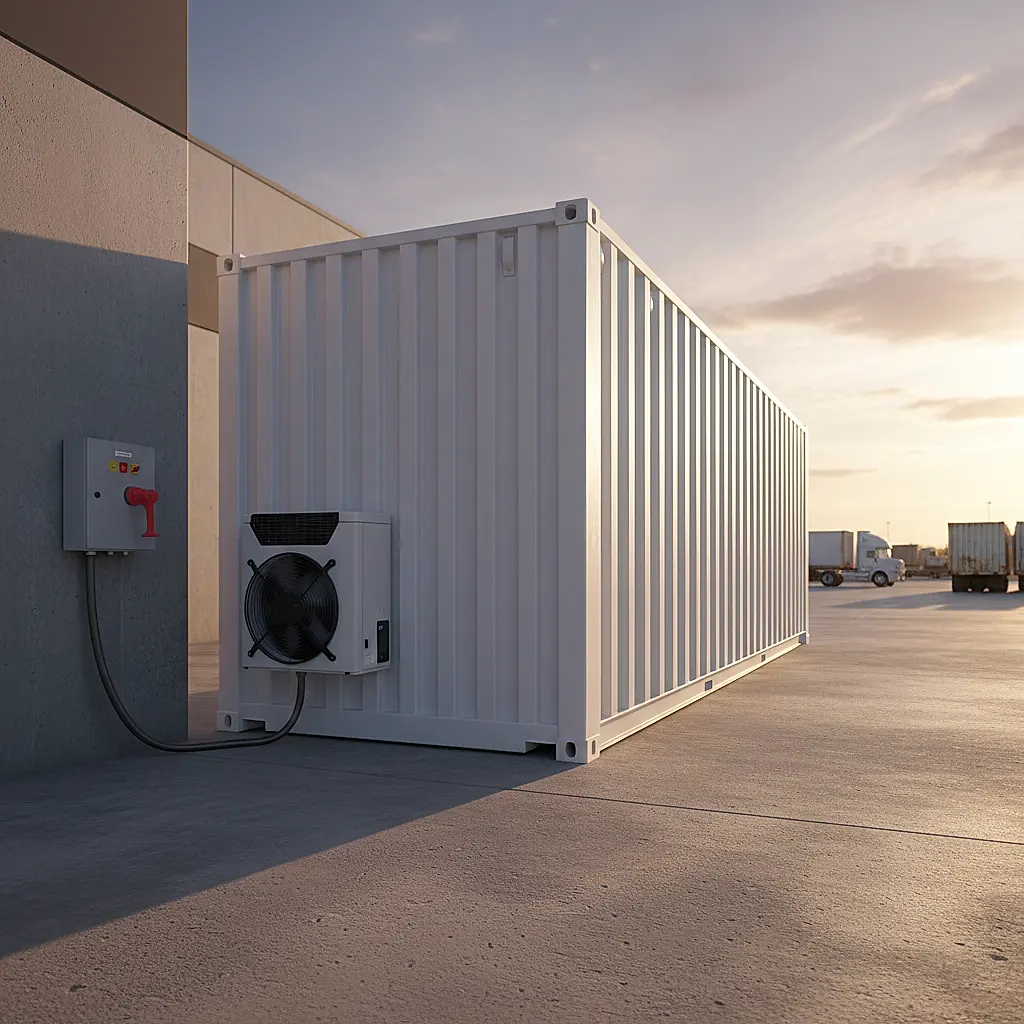
Reefer containers need more than a flat spot and an extension cord. This guide walks through electrical service questions, site planning, and the decisions to confirm before you buy.
A refrigerated shipping container, often called a reefer, is a working refrigeration system inside a steel box. That changes the planning conversation. You are not just choosing a container size; you are arranging a power supply, a safe location, and a service plan for equipment that may run around the clock.
This guide focuses on the practical questions buyers and project planners ask about reefer power and setup. It does not replace the data plate on the unit, the manufacturer's manual, or the advice of a licensed electrician. Treat it as a checklist for the conversations you need to have before delivery day.
What Makes a Reefer Different From a Dry Container
A standard dry container stores goods. A reefer actively manages temperature, and that means it has a compressor, fans, controls, and a power requirement. The refrigeration machinery is typically built into one end of the container, and the unit needs continuous power to hold temperature.
The reefer is an appliance, not just a box
Because it is an appliance, it has electrical characteristics that must be matched to your site. Voltage, phase, amperage, breaker type, conductor size, disconnect method, and grounding all matter. The correct values come from the specific unit you are buying, not from a general rule of thumb.
Temperature control depends on power quality
A reefer that loses power is no longer refrigerating. If you are storing temperature-sensitive goods, think through what happens during an outage, a tripped breaker, or a maintenance window. Backup power, alarms, and monitoring are site-specific decisions you should discuss with your electrician and, where relevant, your insurer.
Not every reefer is set up the same way
Reefers are built for different markets and applications. Some are designed around one electrical standard, and some can be configured for more than one. The only reliable source for your unit is its data plate, its manual, and the documentation that comes with it. Confirm those details with the Newport team before you commit to a power plan.
Electrical Service: The Questions to Answer First
Most of the uncertainty in a reefer project sits in the electrical service. The goal is not to guess a number; it is to gather the right information and hand it to a qualified electrician.
Start with the unit's data plate
Before you call an electrician, get the electrical information from the specific container you are considering. Ask the Newport team to help you locate and read the relevant nameplate or documentation. Typical nameplate information includes voltage, frequency, phase, and running or rated current. Those are the inputs your electrician needs.
Voltage, phase, and frequency are not interchangeable
A service that does not match the unit can damage equipment or simply fail to start it. Do not assume that a particular voltage or phase arrangement is universal. Do not assume a unit can be re-wired for a different service without confirming that with the manufacturer's documentation and a qualified technician.
Breaker and conductor sizing belong to a licensed electrician
Breaker size, wire gauge, conduit, disconnect placement, and overcurrent protection depend on the unit's ratings, the length of the run, local code, and the conditions at your site. This is not a place for internet shortcuts. Have a licensed electrician review the unit documentation and design the circuit.
Ask about starting current, not just running current
Refrigeration equipment can draw more current at startup than while running. Your electrician will want to account for that when sizing the circuit and any generator or backup source. The exact figures come from the unit documentation, not from a general estimate.
Plan the plug, cord, and disconnect
Reefer units are connected in different ways. Some use an industrial-style plug and receptacle; others are hard-wired. The connection method, the location of the disconnect, and the protection from weather and physical damage are all design decisions. Confirm what your specific unit uses before ordering parts.
Site Planning for a Powered Reefer
A reefer needs a location that supports both the container and the electrical work. A few planning choices early can save a lot of rework later.
Ground conditions and support
A loaded reefer is heavy, and the refrigeration end adds machinery. The surface needs to be stable and well drained. If you are placing it on soil, gravel, or an existing pad, discuss the base preparation with the Newport delivery team and, if needed, a local contractor. Exact weight and point-loading information should come from the listing and the delivery team.
Airflow around the refrigeration unit
The condenser needs to reject heat. If the unit is boxed in, crowded by a wall, or sitting in a pocket of still air, performance and reliability can suffer. Leave room for service access and for air movement around the machinery end. Your manual and the delivery team can help you understand the clearances for your specific model.
Drainage and condensation
Refrigeration produces condensate. Think about where that water goes and how the area drains. A level, well-drained pad and a plan for runoff keep the site cleaner and reduce slip hazards.
Access for delivery and for service
Delivery of a reefer involves a truck and the equipment needed to set the container. Access routes, overhead obstructions, gate widths, and turning room all matter. So does future service access: a technician needs to reach the machinery, and you need to reach the disconnect. Walk the route and the final position with the Newport team before scheduling.
Security and monitoring
Because a reefer is running equipment, consider how you will know if it stops. Options range from a simple visual check to remote monitoring and alarm systems. What makes sense depends on what you are storing and how far away you are. Discuss monitoring options with the Newport team and with your electrician.
Understanding Setup Costs Without Guessing
Setup cost for a reefer is not a single line item. It is a bundle of site-specific work, and the honest answer is that it varies. Here is how to think about the categories.
The container itself
Container pricing depends on the specific unit, its condition, and availability. Confirm current pricing and listing details with the Newport team rather than relying on general figures you may see online.
Electrical work
The electrical scope can range from a short run to a new service, panel work, trenching, conduit, and a disconnect. A licensed electrician who has seen the unit documentation and walked the site is the right person to estimate this.
Site preparation
Grading, gravel, a concrete pad, or other base work may be needed. So may drainage improvements. These costs depend entirely on your ground conditions.
Delivery and placement
Delivery charges and any special handling depend on distance, access, and the equipment required. The Newport team can explain what delivery to your location involves and what site conditions they need.
Ongoing operating costs
A reefer consumes electricity whenever it runs. The amount depends on the unit, the setpoint, the ambient conditions, and how often the doors are opened. Your electrician and the unit documentation can help you estimate, but treat any estimate as an estimate.
Maintenance and service
Refrigeration equipment needs periodic attention. Ask about service access and what local refrigeration technicians are available in your area. A plan for service is part of the real cost of ownership.
Common Planning Mistakes to Avoid
- Buying a reefer before confirming the electrical service available at the site.
- Assuming a unit can be plugged into any available outlet.
- Skipping the electrician and sizing a circuit from a forum post.
- Placing the container so the machinery end is blocked or starved of airflow.
- Forgetting drainage and then dealing with standing water.
- Not planning for what happens during a power outage.
- Assuming delivery is simple without walking the access route.
Frequently Asked Questions
What electrical information do I need before buying a reefer?
You need the electrical details from the specific unit you are considering, typically found on the data plate or in the unit documentation. That usually includes voltage, frequency, phase, and current ratings. Ask the Newport team to help you identify those details, then give them to a licensed electrician who can design the circuit.
Can I run a reefer from a standard household outlet?
Do not assume so. Reefer units are typically designed for commercial or industrial power, and connecting one to an undersized circuit can be unsafe or ineffective. The correct answer depends on the unit's ratings and your site's service. Confirm both with the unit documentation and a licensed electrician.
Do I need a permit to install a reefer container?
Requirements vary by jurisdiction and by how the container will be used and connected. Some projects involve electrical permits, zoning review, or both. Check with your local building and electrical authorities, and confirm site requirements with the Newport team, before you finalize your plan.
How much does it cost to set up a reefer container?
There is no single number. Cost depends on the container you choose, the electrical work your site needs, site preparation, delivery, and ongoing power and maintenance. Get a quote from a licensed electrician and confirm container pricing and delivery details with the Newport team.
Can a reefer container be used for cold storage or a walk-in cooler?
Reefers are used for temperature-controlled storage in many applications, but suitability depends on the unit, the temperature range you need, and how the space will be used. Discuss your intended use with the Newport team and confirm the unit's capabilities from its documentation before you buy.
Next Steps
Start by identifying the unit you are interested in and collecting its electrical documentation. Then talk to a licensed electrician about your site, and talk to the Newport team about availability, listing details, delivery access, and what they need from you to place the container safely.
- Browse current options on the shop page.
- Ask about a specific unit's documentation and delivery requirements through the contact page.
- Have your electrician review the unit data before you schedule delivery.
A reefer project goes smoothly when the electrical and site questions are answered first. Confirm the details that matter for your unit and your location, and you will be in a much better position to plan the rest.
Plan the next step
Confirm the container and the delivery plan.
Browse current listings, then speak with the Newport team to verify the unit, total pricing, site access, and delivery requirements before payment.