
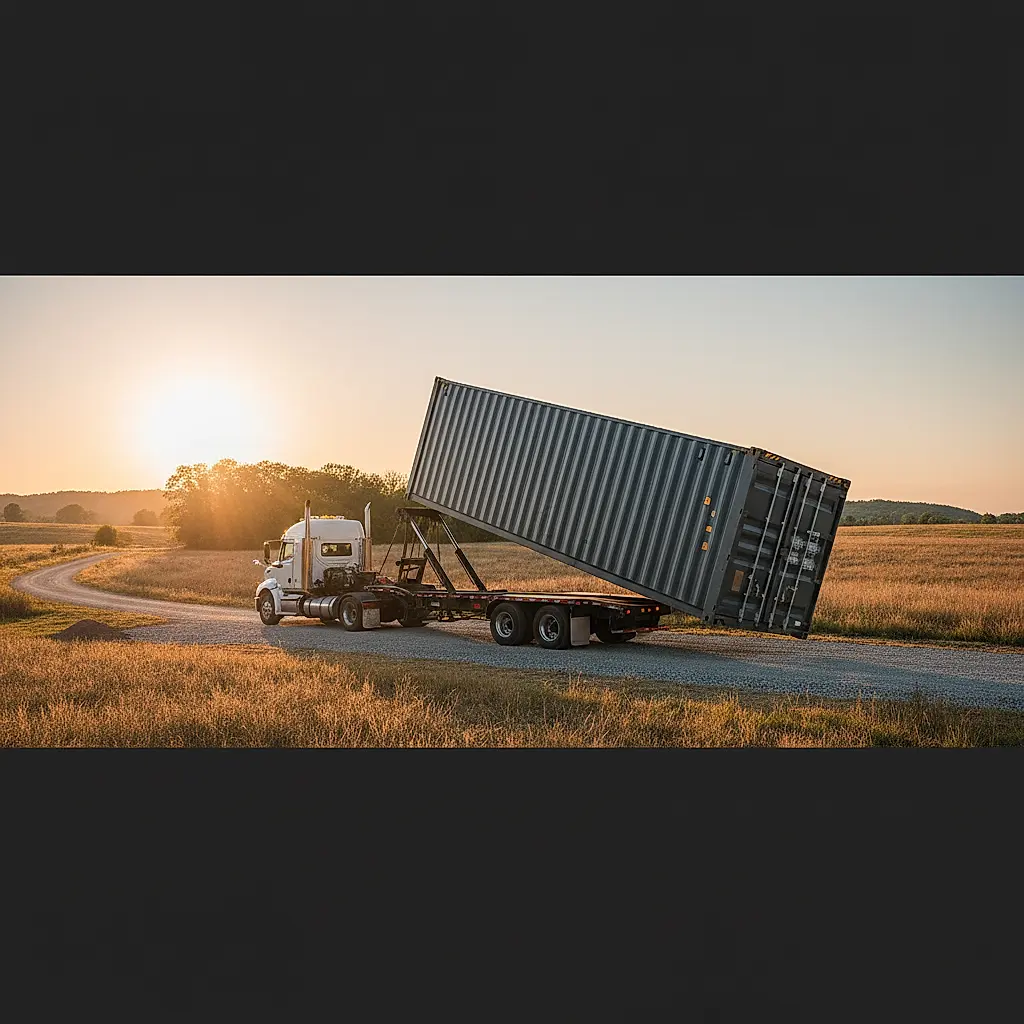
Delivery cost per mile is only one part of a container freight quote. Learn the real factors that shape pricing, how to compare truck types, and what to confirm before you buy.
Why a Simple 'Per Mile' Rate Is Hard to Pin Down
If you search for shipping container delivery cost per mile, you will find plenty of rough ranges. What you will not find is a single number that applies to every delivery. Container freight pricing is quoted per trip, not per mile, because the mile is only one input among many.
Trucking companies build a quote from fuel, driver time, permits, equipment, and the realities of your site. A short local move with easy access can cost less per mile than a long haul, and a long haul can cost less per mile than a short one with tight access. That is why two neighbors can receive similar containers for different amounts.
This guide explains the factors that move a delivery quote up or down, how to compare tilt bed and flatbed options, and what to confirm with the Newport team before you commit. It does not publish rates, because rates change with fuel, season, and carrier availability. Treat any per-mile figure you see online as a starting point for a conversation, not a final price.
The Main Factors That Shape a Container Delivery Quote
Distance and route type
Distance matters, but not in a straight line. Carriers think in loaded miles, deadhead miles (the distance the truck travels empty to reach you), and route complexity. A delivery that requires highway driving, then narrow county roads, then a final approach may take longer than the mileage suggests.
Local deliveries within a metro or county often carry a minimum charge. Long-distance deliveries may be priced as a dedicated haul or combined with other freight. Ask whether your quote assumes a direct trip or a shared route.
Truck and trailer type
Two common setups move shipping containers:
- Tilt bed (roll-off) trucks: The bed tilts and the container slides or rolls off. These are often used where the container can be placed on a firm, level surface close to the truck.
- Flatbed trucks with a crane or boom: The container is lifted and set down. This can help when placement is farther from the truck or when the container needs to be swung into position.
Each setup has different equipment costs and site requirements. Neither is automatically cheaper. The right choice depends on your site, the container size, and what the carrier has available.
Container size and weight
A longer or taller container can require different equipment and may affect routing. Standard and high-cube heights are both common, and the exact dimensions of any unit should be confirmed on the individual listing and the CSC plate. Weight matters too: an empty container is one thing, but a loaded container is a different job entirely. If you plan to load before delivery, say so early.
Site access and placement
This is where many quotes change after a site visit or a photo review. Carriers need to know:
- Surface type: paved, gravel, dirt, or grass
- Slope and drainage
- Overhead obstacles: tree limbs, power lines, awnings
- Gate width, fence lines, and turnaround space
- Distance from the truck's stopping point to the final placement spot
A site that looks simple on a map can be difficult in person. Photos and a short video help the Newport team give you a more accurate picture.
Permits, escorts, and local rules
Some routes and loads require permits or escorts. Requirements vary by state, county, and even by road. Do not assume a particular container size avoids permits; that is a question for the carrier and your local authority. If a permit is needed, it can add cost and time.
Timing and availability
Rush requests, weekend deliveries, and holiday scheduling can affect pricing. So can carrier availability in your area. Booking ahead usually gives you more options.
Tilt Bed vs. Flatbed: How to Think About the Choice
When a tilt bed may fit
Tilt bed delivery can work well when the container can be placed on a firm, level surface near the truck's path. The driver needs room to tilt and slide the container without hitting obstacles. If your site has a wide, stable approach and a clear landing area, this option may be practical.
When a flatbed with lifting equipment may fit
If the container needs to be set farther from the truck or placed over a fence line, a lift may be required. This can also help when the ground is uneven or when you want more control over final positioning. The trade-off is that lifting equipment may cost more and may need additional space to operate.
Questions to ask before you choose
- Can the truck reach the placement point without backing through a tight space?
- Is the ground firm enough to support the truck and the container?
- Are there overhead lines or branches in the path?
- Will the container be empty or loaded at delivery?
- Does the carrier carry the equipment needed for your site?
There is no universal winner. The best choice is the one that matches your site and your container.
How to Compare Quotes Without Getting Misled
Look at what is included
A low per-mile number can hide extra charges. Ask whether the quote includes fuel, permits, escorts, waiting time, and any site-specific equipment. Ask what happens if the driver cannot place the container on the first attempt.
Confirm the scope in writing
Before you pay a deposit, get the scope in writing. It should describe the container, the delivery address, the placement expectations, and who is responsible for site preparation. If something is unclear, ask.
Beware of numbers without context
A per-mile rate without route, equipment, and site details is not comparable to another quote. Two carriers may quote the same mileage but different totals because one includes a permit and the other does not, or because one uses a tilt bed and the other sends a crane truck.
Factor in your own preparation
Your costs do not end with the freight bill. You may need to prepare a level pad, remove obstacles, or arrange for equipment to move the container after delivery. These are real costs, even if they are not on the carrier's invoice.
A Practical Checklist Before You Request a Quote
Use this list to gather what the Newport team needs:
- Container size and type: Confirm the listing details, including nominal length, width, and height.
- Delivery address: Include any gate codes or access notes.
- Site photos: Show the approach, the placement spot, and any obstacles.
- Surface and slope: Describe the ground and whether it is level.
- Overhead clearance: Note trees, wires, and structures.
- Timing: Share your preferred window and any flexibility.
- Loading plans: Say whether the container will be empty or loaded.
- Local requirements: Ask your local authority about permits or restrictions.
A complete request helps the team give you a realistic answer instead of a guess.
Frequently Asked Questions
Is there a standard shipping container delivery cost per mile?
No single standard rate applies to every delivery. Carriers quote per trip based on distance, equipment, site access, permits, fuel, and timing. A per-mile figure can be a useful starting point, but it is not a final price. Confirm the full scope with the Newport team.
Does a tilt bed cost less than a flatbed with a crane?
Not always. The equipment that fits your site is the one that matters. A tilt bed may be simpler for easy access, while a lift may be necessary for tight or distant placement. Ask the carrier which setup your site requires and how that affects the quote.
Can I get an exact quote without a site visit?
Sometimes a detailed description and photos are enough. Other times the carrier may need more information or a visit. Accuracy improves when you share clear photos, measurements, and access details. The Newport team can tell you what is needed for your situation.
Do I need a permit for my container delivery?
Permit rules vary by location and route. Do not assume a particular container size avoids permits. Check with your local authority and ask the carrier whether any permits or escorts are required for your delivery.
What should I do if my site is not ready?
Tell the carrier before delivery day. If the placement area is not level, clear, or accessible, the driver may be unable to complete the delivery. Rescheduling can add cost. Preparing the site in advance is usually the safer path.
Next Steps: Get a Quote That Fits Your Site
Delivery pricing makes more sense when you focus on the whole job rather than a single per-mile number. The container, the truck, the route, and your site all interact. The more detail you share, the more useful the quote.
Start by browsing available units at our shop. Then reach out through our contact page with your address, site photos, and the container size you are considering. The Newport team can help you confirm listing details, availability, pricing, site access, and delivery requirements before you commit. If you are still comparing sizes, ask about the differences between standard and high-cube heights and how each might fit your plan.
Plan the next step
Confirm the container and the delivery plan.
Browse current listings, then speak with the Newport team to verify the unit, total pricing, site access, and delivery requirements before payment.